
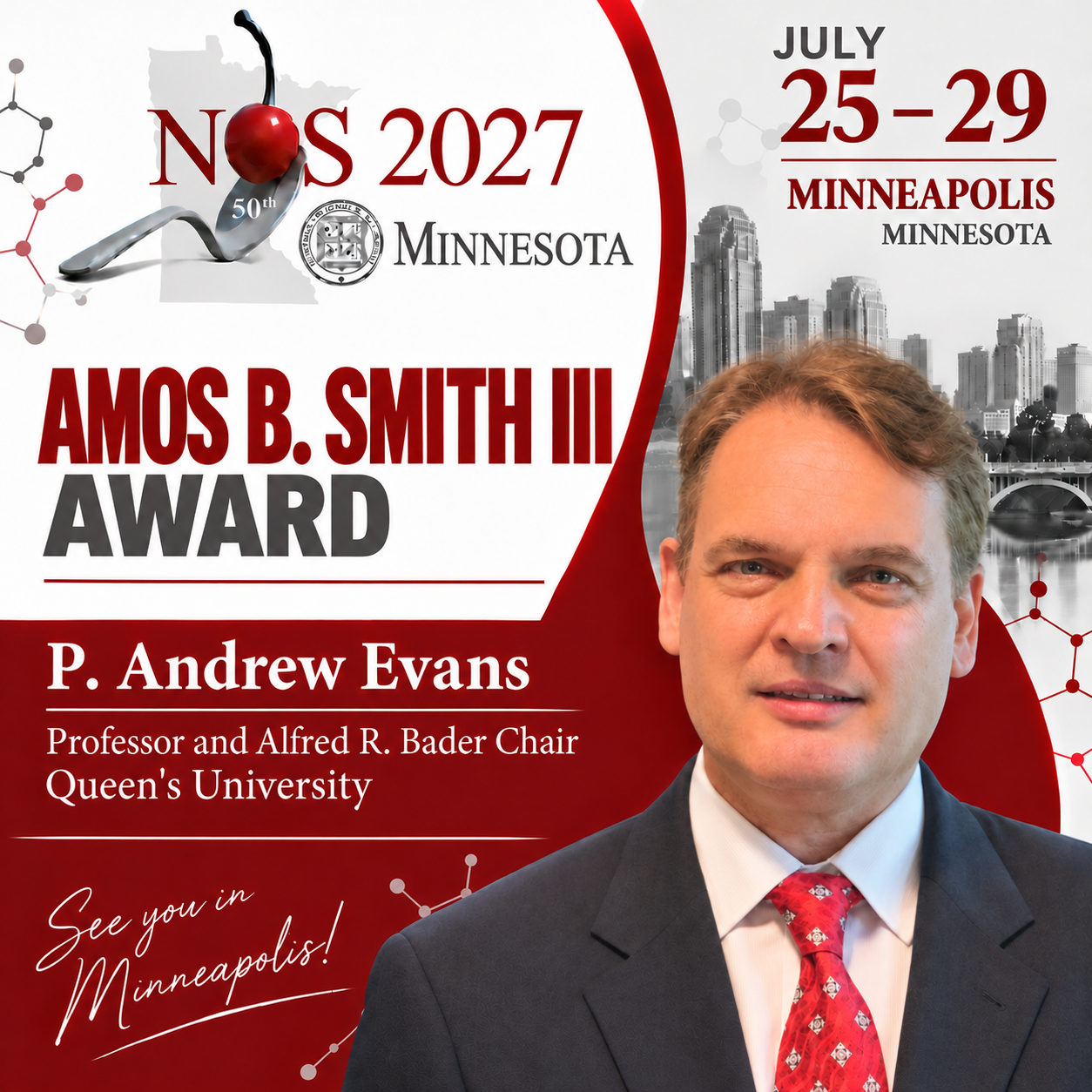
The American Chemical Society Division of Organic Chemistry has named Professor P. Andrew Evans of Queen’s University the inaugural recipient of the Amos B. Smith III Award. The award recognizes research innovation, collaboration across disciplines, and leadership in organic chemistry, qualities that distinguished Professor Smith’s career at the University of Pennsylvania.
Research innovation
Prof. Evans pioneered rhodium-catalyzed allylic substitution, enabling regioselective and stereospecific coupling of acyclic, unsymmetrical chiral allylic electrophiles with achiral nucleophiles. His group then used chiral rhodium catalysis to couple achiral allylic electrophiles with challenging prochiral nitrile anions, aldehyde enolates, and synthetic homoenolate equivalents. The first direct asymmetric alkylation of a nitrile anion gave acyclic quaternary carbon stereocenters, as did the aldehyde-enolate reactions. Evans uses the challenges of total synthesis to drive reaction design, a hallmark of Smith’s research. More recent examples include a bioinspired route to thapsigargin and a synthesis of the antibiotic marinomycin A, whose two halves the team joined using a salicylate group as a chemical switch.
Collaborations
Over nearly 25 years, Evans and computational chemist Mu-Hyun Baik, now at KAIST, have combined theory and experiment to explain rhodium’s selectivity and develop higher-order carbocyclizations that form several carbon–carbon bonds in one step. Evans also worked with Rebecca Goss at the University of St Andrews and Grahame Mackenzie at the University of Hull to protect marinomycin A from ultraviolet light using shells derived from plant spores. At Queen’s, he and electrochemist Gregory Jerkiewicz showed that inexpensive nickel foam selectively reduces nitroarenes to anilines at room temperature. Also at Queen’s, Evans worked with structural biologist John Allingham and cancer biologist Andrew Craig on a new strategy to target metastasis, which accounts for most cancer deaths. Their simplified mycalolide B analog disrupted actin and inhibited cancer cell migration and invasion in laboratory studies.
Leadership
A former Division chair, Evans co-founded the Graduate Research Symposium with Prof. Gary Molander in 2010. More than 1,000 graduate students have presented their research and met mentors from academia and industry through the symposium. The program has earned the Division three ACS ChemLuminary Awards. Prof. Evans serves as president of Organic Reactions and was its first editor-in-chief based outside the United States. He initiated and led the series’ transition to free online access, making its authoritative reviews available to chemists worldwide.
Twenty years after organizing the 40th National Organic Chemistry Symposium at Duke University, Prof. Evans will deliver the inaugural award address at the 50th symposium, July 25–29, 2027, at the University of Minnesota.
About the award
The Amos B. Smith III Award was established by the ACS Division of Organic Chemistry in 2026 to honor the legacy of Professor Amos B. Smith III (1944–2025), whose distinguished career exemplified the highest ideals of organic chemistry: transformative scientific achievement, sustained mentorship, and exceptional leadership to the scientific community. The award is designed not merely to honor excellence but to help define it for future generations. Through this award, the Division seeks to foster the continued advancement of organic chemistry by celebrating those who embody Professor Smith’s commitment to scientific discovery, collaboration, and service.
About P. Andrew Evans
Prof. Evans holds the Alfred R. Bader Chair in Organic Chemistry in the Department of Chemistry at Queen’s University in Ontario, Canada. He previously held a Tier 1 Canada Research Chair in Organic and Organometallic Chemistry. He received a B.Sc. with honors in Applied Chemistry at Newcastle Polytechnic in 1987 and a Ph.D. at the University of Cambridge in 1991 under the supervision of Andrew B. Holmes, FRS. He then completed postdoctoral studies with Philip D. Magnus, FRS, at the University of Texas at Austin as a NATO Postdoctoral Fellow. He began his independent career at the University of Delaware in 1993 and was promoted to professor in 2000. He moved to Indiana University in 2001 and to the University of Liverpool in 2006, where he held the Heath Harrison Chair of Organic Chemistry. He began his current appointment in July 2012.